The Physics of Winter Concrete Failure and the Case for Penetrating Sealers
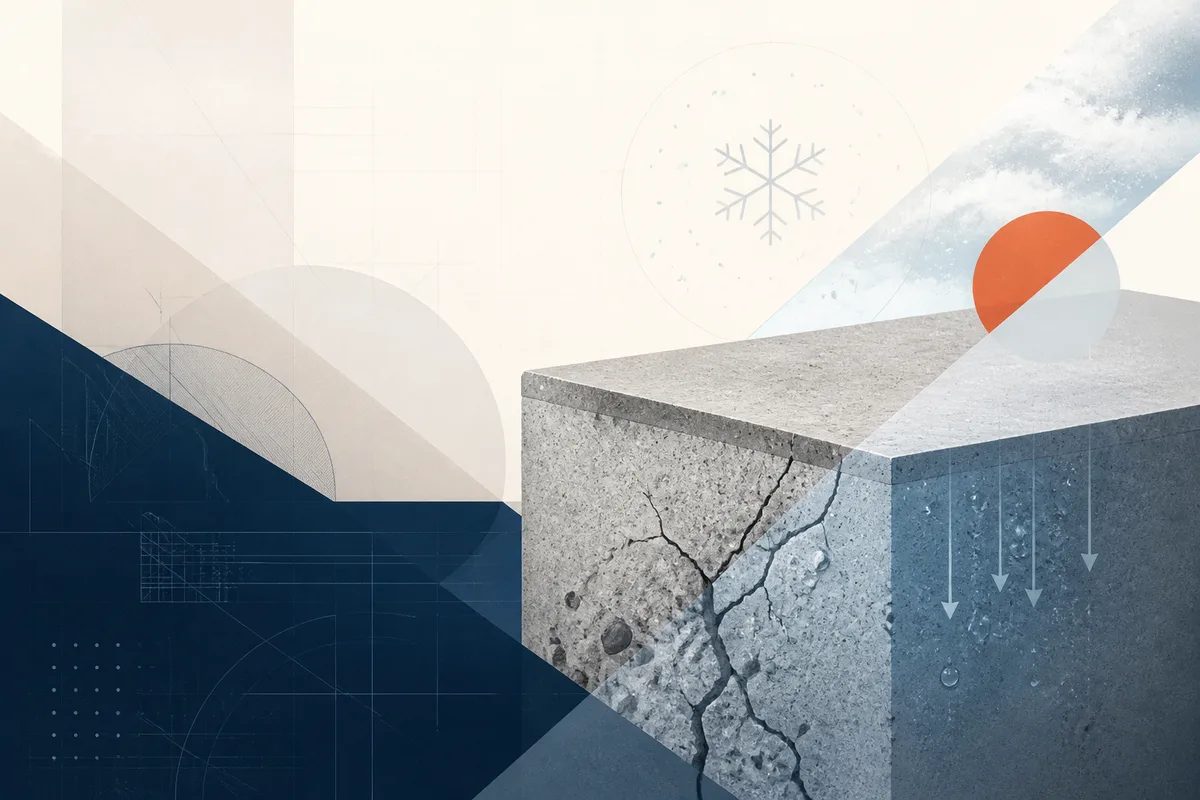
Unsealed concrete functions like a hard sponge. Even though a driveway or patio looks solid, it is riddled with microscopic capillaries that pull moisture deep into the slab through capillary action. When temperatures in Oklahoma City drop, that moisture undergoes a phase change, expanding in volume and creating internal pressure against the pore walls. According to ChemMasters, penetrating water repellents protect concrete from this freeze/thaw damage without changing the surface appearance (ChemMasters).
This article outlines the mechanical causes of surface scaling and why preventing concrete spalling in winter requires a shift from superficial coatings to sub-surface chemistry. For homeowners managing large exterior slabs, understanding the trade-offs between penetrating vs acrylic sealer is essential for maintaining a durable surface.
Why Standard Exterior Concrete Fails in Cold Weather
Most exterior concrete damage is not caused by the cold itself, but by the water the concrete is allowed to hold. When the internal pressure of freezing water exceeds the tensile strength of the concrete, the surface ruptures. As noted by Slabjack Geotechnical, spalling—the flaking, chipping, or pitting of a concrete surface—is a common issue for driveways and commercial slabs exposed to moisture (Slabjack Geotechnical).
- Repeated freeze-thaw cycles in the transition months cause incremental micro-fracturing that eventually leads to visible flaking.
- The application of rock salt lowers the freezing point of water, which increases the number of daily freeze-thaw cycles the concrete must endure.
- Subsurface moisture migration can lead to delamination if a non-breathable sealer traps water vapor beneath the surface during a hard freeze.
- Existing hairline cracks act as funnels, directing bulk water to the rebar or wire mesh where it causes corrosion and expansive rusting.
The Professional Playbook for Winterizing Outdoor Concrete
Preparation for winter begins long before the first frost. A systematic approach to concrete sealing ensures the substrate is chemically altered to reject water rather than just covered with a temporary film.
1Clear the Surface of Latent Contaminants
Before any protective agent is applied, the slab must be free of oils, efflorescence, and previous failing coatings. Applying a sealer over road salt or organic growth may compromise the effectiveness of the application, leaving the concrete vulnerable to winterizing outdoor concrete issues. Professional cleaning typically involves high-pressure washing and, in some cases, mechanical abrasion to open the pores.
2Differentiate Between Film-Forming and Penetrating Agents
Acrylic sealers create a visible sheen and are excellent for interior stained floors, but they can be slippery and prone to peeling on driveways. For exterior longevity, silane-siloxane blends are often preferred. These chemicals react with the silica in the concrete to form a hydrophobic barrier that does not wear away with tire traffic. Research from the CP Tech Center indicates these penetrating sealers show promise for increasing durability by reducing moisture and chloride ion penetration (CP Tech Center).
3Time the Application for Optimal Absorption
Concrete chemistry is sensitive to ambient temperature and moisture levels. According to the Oklahoma Department of Transportation, winter weather can impact construction schedules, with potential suspensions between December 21st and February 15th (Oklahoma DOT). For a sealer to cure correctly, the slab must be dry and temperatures should remain above freezing throughout the reaction period to ensure the sealer helps protect the concrete (Deco-Crete Supply).
4Address Structural Vulnerabilities
Sealing the surface will not stop a structural crack from widening during a freeze. All expansion joints should be inspected to ensure the flexible filler is intact. If water can bypass the sealer by flowing into an open joint, the freeze-thaw pressure will simply attack the slab from the side or bottom, leading to heave and displacement.
The Mechanism of Concrete Salt Damage Prevention
Salt does not "eat" concrete in the way acid does; rather, it facilitates a destructive physical process. Salt is hygroscopic, meaning it attracts and holds water. When salt is spread on a driveway, it creates a brine that penetrates deeper into the concrete than pure water would.
Once that brine eventually freezes, it creates hydraulic pressure. Furthermore, the salt can crystallize within the pores, creating internal growth that shatters the concrete from the inside out. Using a penetrating sealer creates a "beading" effect where the brine is kept on the surface, allowing it to evaporate or run off without entering the pore structure. This effectively prevents spalling by creating a protective barrier against moisture and de-icing salts (SpecChem).
How OKC Concrete Staining Helps
Managing exterior concrete requires an understanding of local soil movement and rapid temperature shifts. A typical service engagement begins with a mechanical assessment of the slab's current porosity and the removal of any failing topical treatments. The scope of work generally involves deep cleaning, moisture testing, and the application of industrial-grade silane-siloxane sealers that allow the concrete to breathe while remaining water-repellent.
Frequently asked questions
Does sealing concrete prevent all types of cracking?
No, sealing primarily prevents surface spalling and scaling caused by water expansion. It does not prevent structural cracks caused by soil settling, tree roots, or heavy vehicle loads that exceed the slab's design capacity.
How often should I reapply a sealer to my driveway?
Exterior slabs require periodic re-treatment to maintain their hydrophobic properties. The frequency depends on the volume of vehicle traffic, exposure to harsh winter conditions, and the amount of salt used during the winter months.
Can I apply a penetrating sealer over an old acrylic coating?
No, penetrating sealers must reach the raw concrete pores to function. If an old acrylic or "wet look" sealer is still present, it will block the new sealer from absorbing, causing it to pool on the surface and fail to protect the substrate.
Is it too late to seal my concrete if it has already started flaking?
Sealing can slow down further degradation, but it cannot reverse existing spalling. If the surface is already crumbling, a repair mortar or resurfacing agent may be needed before a sealer is applied to stabilize the remaining structure.
Does the City of OKC require permits for residential driveway sealing?
According to the City of OKC, permits are generally required for new construction, add-ons, and remodels. While simple maintenance sealing typically does not require a permit, any work involving the replacement or expansion of the driveway footprint should be verified with the city at (405) 297-2525.
What happens when you get in touch: the situation is described, questions are asked that clarify the requirements, and a clear scope and next step is provided—no obligation.
Local note: The Contractor may request a winter time suspension of time charges and work during the time period between December 21st and the following February 15th. (Oklahoma DOT)